

RCCHU Workshop: Innovations in Medical Imaging: from Deep Learning for Brain Mapping to New Approaches for Monitoring and Improving Radiation Therapy

Date and Time
Location
From Pixels to Meshes: Deep Learning for 2D-to-3D Medical Image Segmentation
Understanding the human brain requires accurately mapping its surface, a process known as cortical parcellation. However, traditional methods struggle with complex brain shapes and require extensive corrections before they can be analyzed. This talk presents Pseudo-Rendering Inverse-Rendering (PRIR), a new deep learning approach that simplifies the problem by turning 3D brain surfaces into easy-to-process 2D images. By capturing different views of the brain’s surface, analyzing them with artificial intelligence, and then reconstructing the 3D structure, PRIR makes brain mapping faster, more accurate, and adaptable to real-world data. This innovation could improve the way researchers study brain diseases, personalize treatments, and analyze medical images with greater precision. The talk will explore how this technique works, why it matters, and broader implications for medical imaging and deep learning applications in neuroimaging.
Speaker: Pablo Blasco Fernández (Visiting Master Student, MSc in Biomedical Engineering ETH Zurich).
Advancing Dose Monitoring in Proton Therapy: From PET Imaging to Ionoacoustic Detection.
Accurate dose verification is essential to ensure the effectiveness and safety of proton therapy to treat tumors. Currently, extensive research is dedicated to developing imaging techniques capable of real-time monitoring of dose deposition in the human body. Among these, PET range verification leverages the detection of positron-emitting isotopes produced by nuclear interactions of the proton beam within the patient. However, this technique is inherently limited by the specific half-life of the isotopes, the need for complex signal reconstruction, and the temporal delay between dose deposition and image acquisition, which can impact its accuracy and clinical usability.
More recently, ionoacoustic detection has emerged as a promising alternative, utilizing acoustic waves generated at the dose deposition site to provide real-time range verification. In this talk, I will discuss the advantages and limitations of both techniques, comparing their clinical feasibility and technological challenges. The research conducted during my PhD at the University of Sevilla and my postdoctoral work at MGH will be presented, highlighting their potential to improve treatment accuracy and adaptability in proton therapy.
Speaker: Teresa Rodríguez González, PhD (Postdoctoral Research Fellow, Massachusetts General Hospital & Harvard Medical School).
High Atomic Number Nanoparticles as Theragnostic Agents for Precision Radiotherapy
High atomic number nanoparticles arouse a special interest in radiotherapy. Multiple studies have already shown their potential use as diagnostic and therapeutic agents, and some nanoparticle formulations have advanced to clinical trials. In diagnostics they can be used as contrast agents, while in therapy they could act as dose enhancers and radiosensitizers. In this talk, we will introduce some of the latest advancements on the usage and possibilities offered by experimental formulations of gold nanoparticles, and AGuIX®/AGuIX-Bi nanoparticles, one of the only two radiosensitizing nanoparticles currently in phase II clinical trials.
Speaker: Jose Antonio Lopez-Valverde, PhD (RCCHU Postdoctoral Research Fellow, Dana Farber Cancer Institute/Brigham and Women’s Hospital, Massachusetts General Hospital & Harvard Medical School).
Leveraging Deep Learning, Monte Carlo Simulations and PET Imaging to Improve Proton Therapy
Over half of all cancer patients receive radiotherapy, a treatment that delivers radiation to tumors to destroy cancer cells. Proton therapy, which targets tumors with high-energy protons, has emerged as a more precise alternative to conventional x-ray-based radiotherapy. However, the precision of proton therapy also makes it particularly sensitive to deviations during treatment, arising from factors such as patient positioning errors or anatomical changes. To tackle this, we developed PROTOTWIN-PET, a deep learning-based tool using Positron Emission Tomography (PET) images and trained through simulations of patient-specific digital twins. PROTOTWIN-PET accurately detects these deviations within milliseconds, enabling treatment adjustments that prevent damage to surrounding healthy tissues and ensure full targeting of the tumor. Moreover, ongoing work is expanding the capability of PROTOTWIN-PET to assess tumor microenvironment through PET imaging, providing valuable biomarkers for improved risk stratification and assessment of tumor progression. This work highlights how advances in PET imaging, deep learning, and simulation, have the potential to improve treatment for cancer patients.
Speaker: Pablo Cabrales (Visiting PhD Candidate, Martinos Center for Biomedical Imaging, Massachusetts General Hospital & Harvard Medical School).
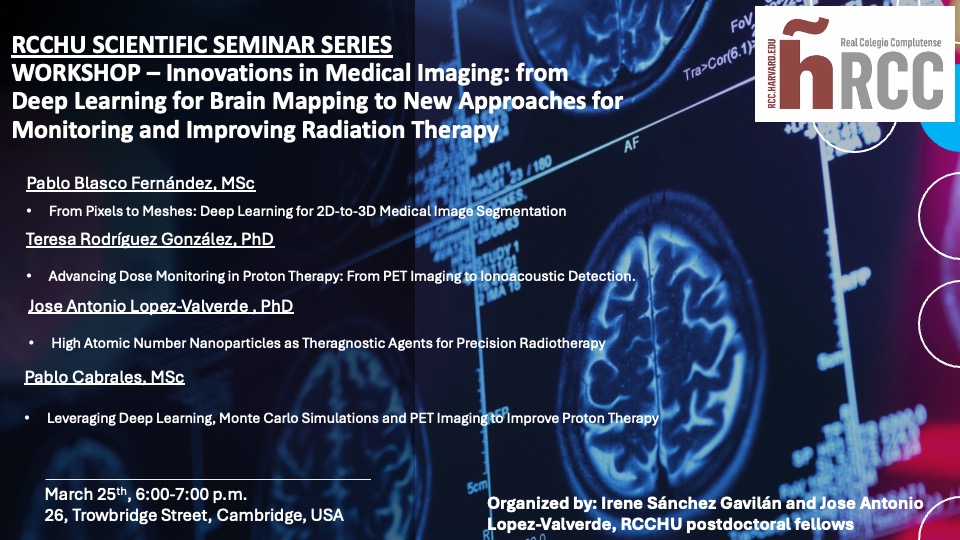
Organized by: Irene Sánchez Gavilán (Postdoctoral Researcher at Division of Preventive Medicine, Harvard Medical School) & Jose Antonio Lopez-Valverde (Postdoctoral Research Fellow, Department of Radiation Oncology, Dana Farber Cancer Institute/Brigham and Women's Hospital & Massachusetts General Hospital - Harvard Medical School).
Sponsors: Real Colegio Complutense at Harvard University (RCCHU); Harvard Medical School; UCM; US.