

UPM SEMINAR SERIES

Date and Time
Location
Exploring acoustic properties of emboli: Enhancing emboli detection and prevention strategies in the context of ECMO
Extracorporeal Membrane Oxygenation (ECMO) system is an artificial life support mechanism designed to aid individuals whose lungs or heart are not properly functioning in oxygenating their blood. This process continuously pumps blood out of the body and sends it through a series of devices that add oxygen and remove carbon dioxide, then returning oxygenated blood to the body. However, utilizing ECMO comes with certain risks, including the potential formation of emboli (both solid and gaseous) which, when entering the body, can lead to ischemia, stroke, or pulmonary embolism, among other complications. The detection and prevention of such emboli remain a major healthcare challenge. We aim tackle this challenge leveraging ultrasonography, an imaging technique that employs sound waves to image organs, tissues, and other structures within the body, in a non-invasively way. In this talk, we will discuss how ultrasonography can be potentially used for detection of emboli within the context of ECMO.
Speaker: Ana Pascual Lopez (Biomedical engineering student in the School of Telecommunication Engineers (ETSIT) at the Technical University of Madrid (UPM).
LAB: Integrative Neuromonitoring and Critical Care Informatics Group.
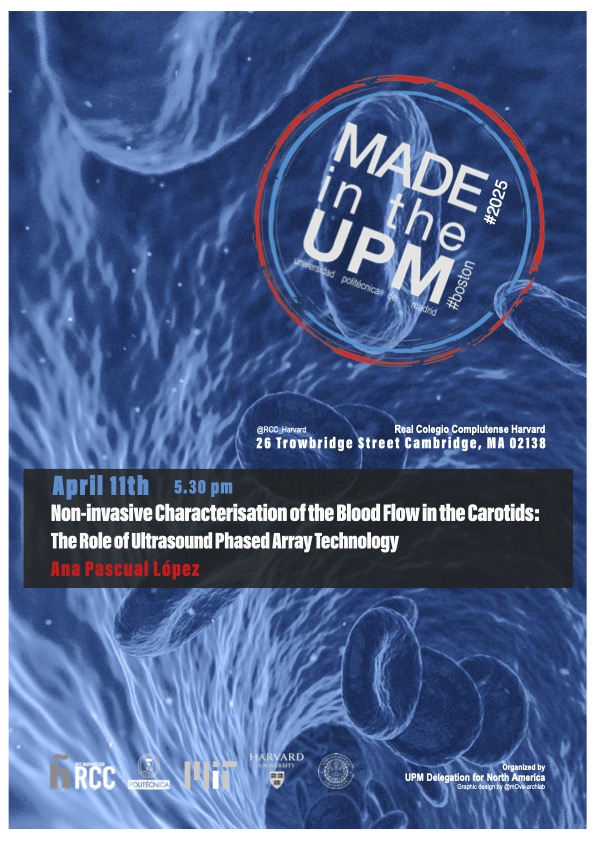
Non-invasive characterization of blood flow in the Carotids: The role of ultrasound phased array technology.
Non-invasive, imaging-based blood flow measurements play a key role in cardiovascular diagnostic assessment, specially in cerebrovascular arteries, such as the internal carotids and cerebral vessels that supply blood to the brain. Ultrasound technologies, in particular, offer a safe, efficient, and accessible way to assess hemodynamic parameters, enabling early detection of conditions like atherosclerosis and stroke risk. While volumetric blood flow is of most physiological relevance, what can be measured with current technologies is the blood flow velocity. Here, we aim to develop a technology that will allow physicians to measure, monitor, and characterize volumetric blood flow in these vital arteries at the patient´s bedside, providing an accurate and quick diagnosis to patients making use of ultrasound. In this talk, we will address the principles, challenges and clinical applications of this vital tool in cerebrovascular health monitoring..

Speaker: Isabela Romero Estevez (Master’s in Electrical Engineering and Computer Science at MIT).
LAB: Integrative Neuromonitoring and Critical Care Informatics Group.