

Made in UPM 2026 Seminar Series

Date and Time
Location
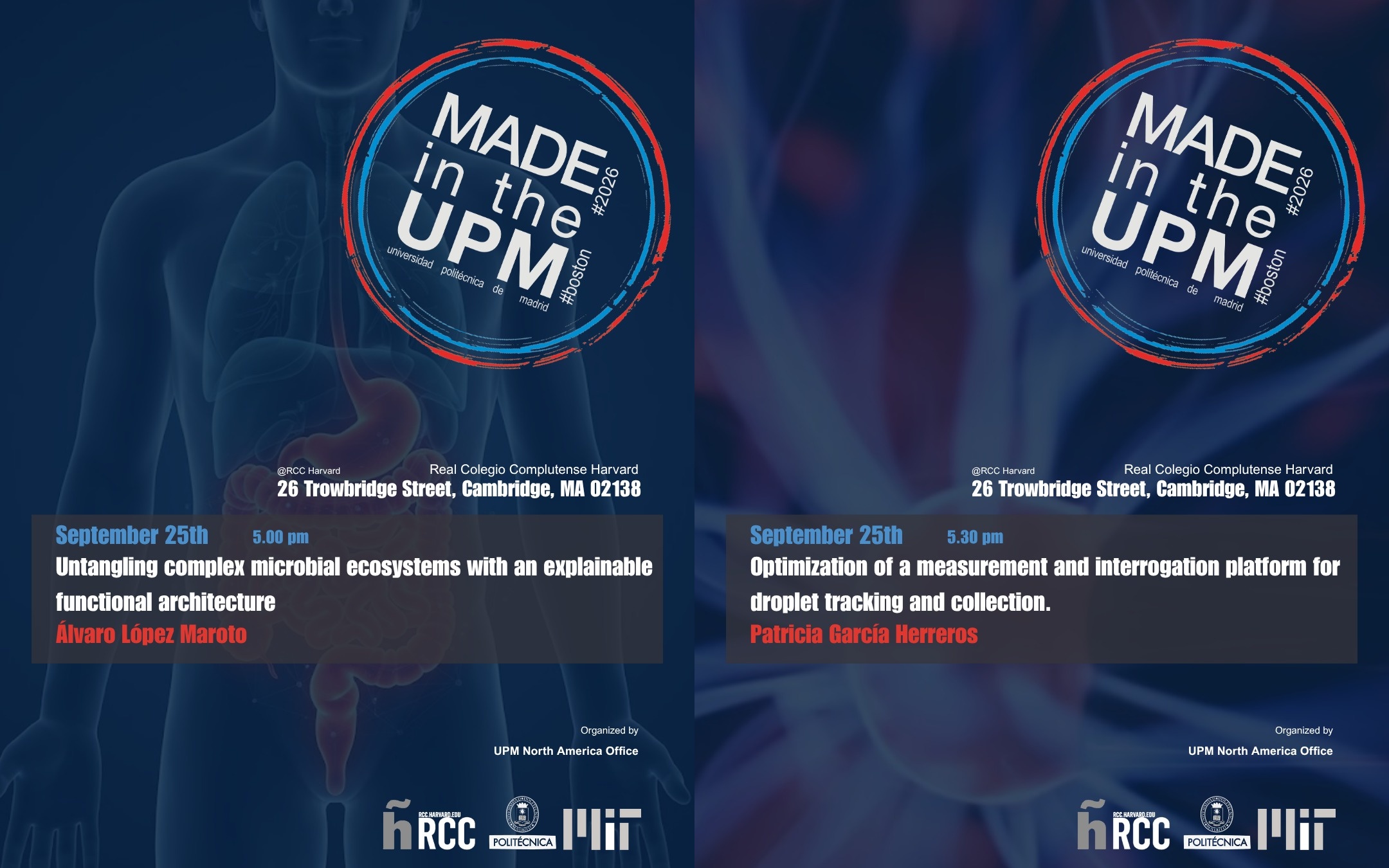
05.00 pm Untangling Complex Microbial Ecosystems with an Explainable Functional Architecture
Since 1990, the prevalence of gut-microbiota-related diseases doubled, while scientific evidence exploded tenfold. Still, when a clinician looks at a patient’s gut profile — packed with thousands of microbial species — connecting it to health insights remains overwhelming. The knowledge exists, but it’s scattered. To make sense of it, we harmonized decades of literature into a single network, grounding an intractable system into an actionable map. By mapping how species interact, patterns emerge: mticrobes organize into functional guilds sharing specific roles in the ecosystem. These guilds simplify the biology even further, translating raw species counts directly into explainable, functional disease biomarkers. Moving from clinical analysis to discovery, this same knowledge network fuels predictive models that generate new hypotheses and explore what remains unmapped.
A biotechnologist from UPM, Álvaro López-Maroto is currently in the final year of his PhD in AI. In his project, Álvaro operates between both fields to push our understanding of microbial communities and capitalize on scientific knowledge to develop innovative pipelines delivering evidence-based predictions. His background combines academic training in biotechnology and synthetic biology (MSc) with hands-on experience in the tech world as an AI engineer at a consultancy. Currently, he is on a one-year research stay at MIT, collaborating with Professor Otto X. Cordero to establish unsupervised methodologies to interpret microbiome data.
05.30 pm Optimization of a Measurement and Interrogation Platform for Droplet Tracking and Collection.
Patricia García Herreros holds a B.S. in Telecommunication Technologies and Services Engineering and is completing dual M.S. degrees in Telecommunication Engineering and in Electronic Systems Engineering, both at ETSIT-UPM. She is currently a visiting student at MIT's Institute for Medical Engineering and Science (IMES).
Her research during her visit focused on optimizing electrostatic and charge affinity of materials to enhance their attraction to capture charged particles and quantify the collection efficacy under controlled environmental conditions. The platform supports the characterization of biophysical/chemical processes in microorganism-containing fluid droplets.
The project combines the development of electronic control systems with the integration of instrumentation and imaging to automate experimental procedures and data acquisition. It also provides quantitative image-analysis tools for evaluating collection performance, supporting a more consistent and reproducible workflow from experimentation to analysis.
By combining electronics, instrumentation, data analysis, and image processing, Patricia’s research strengthens the experimental capabilities needed to study airborne control of charged particles and their analysis.
Link Zoom available