

Calibrated fMRI: Toward a More Direct Measure of Neural Activity

Date and Time
Location
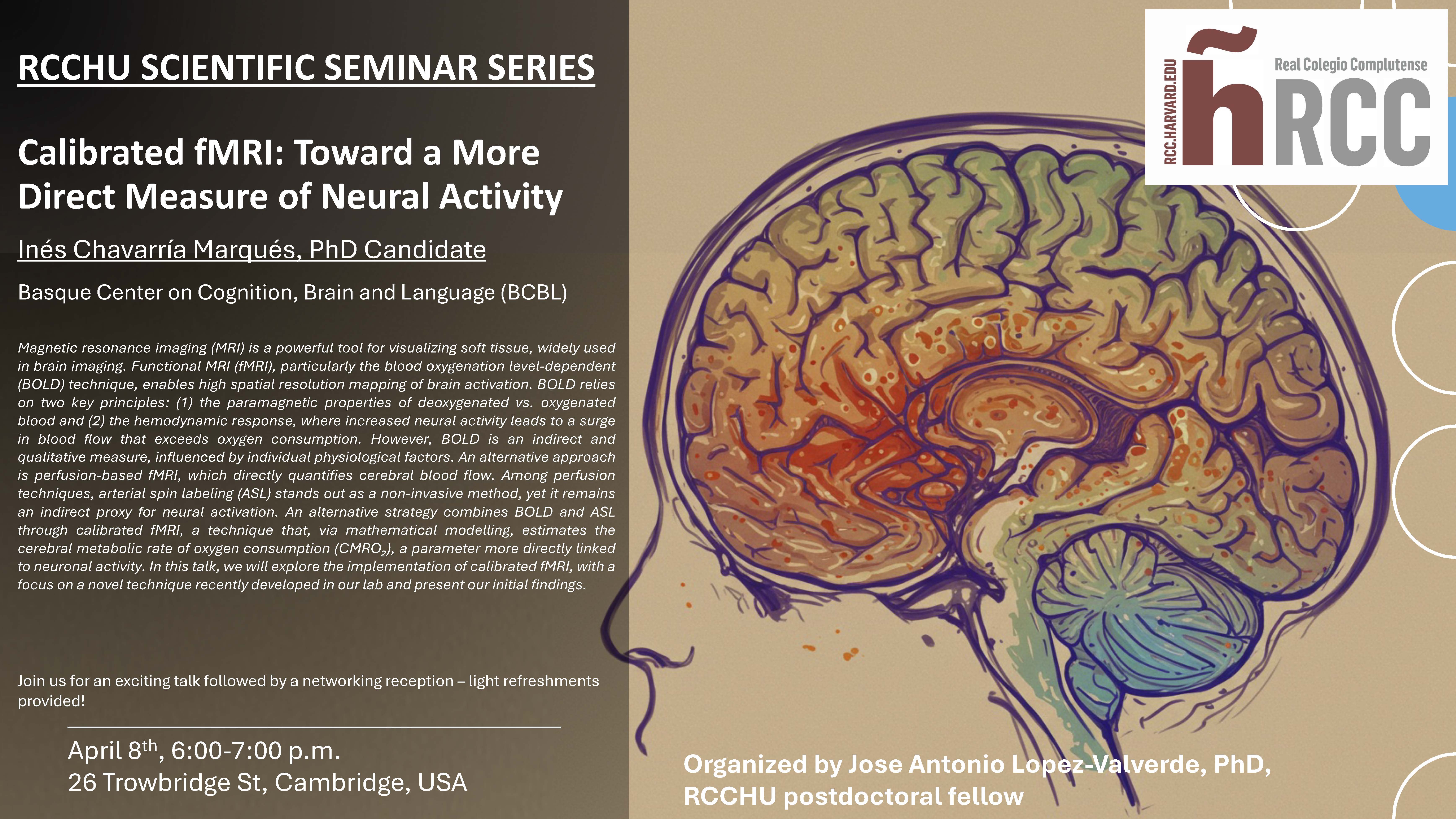
Magnetic resonance imaging (MRI) is a powerful tool for visualizing soft tissue, widely used
in brain imaging. Functional MRI (fMRI), particularly the blood oxygenation level-dependent
(BOLD) technique, enables high spatial resolution mapping of brain activation. BOLD relies
on two key principles: (1) the paramagnetic properties of deoxygenated vs. oxygenated
blood and (2) the hemodynamic response, where increased neural activity leads to a surge
in blood flow that exceeds oxygen consumption. However, BOLD is an indirect and
qualitative measure, influenced by individual physiological factors. An alternative approach
is perfusion-based fMRI, which directly quantifies cerebral blood flow. Among perfusion
techniques, arterial spin labeling (ASL) stands out as a non-invasive method, yet it remains
an indirect proxy for neural activation. An alternative strategy combines BOLD and ASL
through calibrated fMRI, a technique that, via mathematical modelling, estimates the
cerebral metabolic rate of oxygen consumption (CMRO₂), a parameter more directly linked
to neuronal activity. In this talk, we will explore the implementation of calibrated fMRI, with a
focus on a novel technique recently developed in our lab and present our initial findings.
Speaker: Inés Chavarría Marqués (PhD Candidate; Basque Center on Cognition, Brain and Language (BCBL)).
Sponsors: RCCHU; Harvard University; Basque Center on Cognition.